Highland Games
  • Home
  • About
    • Organization
    • History
  • Events
    • Highland Dance
    • Heavy Athletics >
      • Athletics Rules & Events
      • Athletics Registration
    • Piping & Drumming
    • Highland Bagpipe Facts
    • Snare Drum Facts
    • Celtic Entertainment
    • Scottish Country Dancers
    • Shortbread Contest
    • Robert Burns Poetry
    • Celtic Storytelling
    • Highland Cattle Exhibit
    • Sheepherding Exhibition
    • Clydesdale Horse Exhibition
    • Blacksmith Demonstration
    • Photo Exhibit
    • Kid's Games
    • Tug O' War
    • British Car Display
    • Sheepherding Exhibition
  • Clans
  • Sponsorship
    • Corporate Sponsors 2026
    • Individual Sponsors 2026
  • Heritage
  • Volunteers
  • Vendors
  • Scholarships
  • Videos
  • Photos
    • Photos by Sandy Sheehan
    • Photos by Jon Bish
    • Photos by Deborah Townsend
    • Photos by Deboree Baxter
  • Contact Us
2026 Highland Dance Competition
​
​Registration due July 18th, 2026

We invite you to join us for an exciting day of dancing and celebration with events for all skill levels. Our judge for this year is Haley Brogan from Los Gatos, CA, and the competition features our Lilac City Solo Choreography Challenge.

Click the following to download competition information: 
2026 Dance Competition
​

Picture
 2026 Dances
Primary - 16 PDBs, PDBs & HCs, Fling (4), Sword (2&1)
Beginner - Fling (4), Sword (2&1), Seann Triubhas (3&1), Lilt (4), Flora (4)
Novice - Fling (4), Sword (2&1), Seann Triubhas (3&1), Lilt (4), Flora (4)

Intermediate - Fling (4), Sword (2&1), Strathspey & Half Tulloch, Lilt (4), Flora (4), Hornpipe (4)
Premier - Fling (4), Sword (2&1), Strathspey & Half Tulloch, Earl (4), Blue Bonnets (4), Hornpipe (4)
Lilac City Solo Choreography Challenge - Pre-Premier & Premier

General Rules
• The dance competition will begin at 9:30am with registration at 9:00am.
• Front gates will open at 8:30am for dance families and 9:00am to the general public.
Dancers receive free admission to the games.
• Competition will be conducted in accordance with RSOBHD and ScotDance USA
regulations. All dance competitors, teachers, and parents are expected to comply
with the ScotDance USA Code of Ethics.
• All dancers must have valid 2026 registration cards and present them at registration
in order to compete.
• Dancers registering last will be first to dance and may be asked to fill in for reels.
• Age groups will be determined after all registrations have been received.
• Dancers must remain in costume until awards have been presented.
• In accordance with ScotDance USA policies, dancers must not change costumes in
public view.
• The decisions of the Adjudicator are final. Petitions should be filed to the Dance
Chairman no later than 48 hours after the event. The petition should be in writing
giving the complainants full name and address and accompanied with a $25.00 fee
that will be refunded if petition is warranted.
• Competitors must register online no later than Saturday, July 18, 2026. Late entries
must contact the competition organizer and will be subject to a late fee of $15. Entry
fees are non-refundable.

Solo Choreography Rules
• Content should consist primarily of movements from Highland, National, Hornpipe
or Jig.
• Music should be no longer than 2 minutes.
• Music may include vocals or percussion. Music must be predominantly Scottish or
Celtic in style.
• Competitors must email their musical selection exactly as it is to be played (already
cut to the time limit) to the competition organizer [email protected] by
Saturday, July 18th. Please also bring a copy of the music with you to the
competition.
Email the dance competition organizer, Victoria Hawkins, for any questions at [email protected].

About Highland Dancing

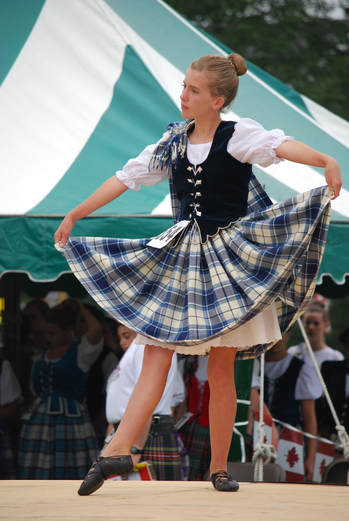
Highland dance has a rich history that has been spread across the world as Scottish people immigrated around the globe. There is nothing that better captures the essence of Scottish culture than the performance of Highland dancing during a celebration.
The first-ever recorded instance of Highland dance, a type of war dancing in its infancy, was in 1285 during the second marriage of Alexander III to Yolande de Dreux. Another instance of Highland dancing in history is the record from 1573, at Stockholm Castle in Sweden, where Scottish mercenaries performed a sword dance for the King of Sweden, John III.
Highland dance traditionally was used as a way for kings and clan chiefs to choose their men at arms. Due to the strength and stamina required to perform Highland dancing, and the discipline needed in learning it, it was considered a good judge of one’s abilities.

The Jacobite uprisings of the 18th century, which sought to restore the Stuart monarchy to the British throne, had a significant impact on Highland dance.
After the defeat of the Jacobites at the Battle of Culloden in 1746, the British government imposed severe restrictions on Highland culture, including the wearing of tartan and the playing of bagpipes. Despite these efforts, Highland dance survived, often performed in secret or adapted into more acceptable forms of entertainment.
After the ban was lifted, much of Scottish tradition had been lost. Thanks to Queen Victoria’s love for Scotland though, the Highland culture was revived and the Highland Games and modern Highland dance formed.  

Highland dance remains an important part of Scottish culture
and identity and you can find it performed at cultural events such
as Robert Burns Night and St. Andrew’s Day. Competitive Highland
dancing is most popular in the UK, Canada, United States, Australia,
and New Zealand. There are standardized steps and dances, specific
Scottish dance attire, 5 set competitive levels, and a governing board. Unlike most dance forms and sports, males and females also compete against each other.


History of the Dances
 
The Highland Fling
This dance from the 17th century, the oldest of the traditional dances, is perhaps the best known and is a victory dance following battle. It depicts a stag frolicking on a mountainside, with the curved arms and hands overhead representing the stag’s antlers, and is the only dance where the tempo of the music does not change and there are no traveling steps. Traditionally, the warriors performed this dance on the small round shield (targe) that they carried into battle. As most targes had a steel spike projecting some five or six inches from its center, one can understand the quick footwork and dexterity the dancers must possess. Because of its precise movements, it is often used in dance-offs to determine the best dancer.
 
Ghillie Callum (Generally called the Sword Dance)
The history of this dance may go back to 77 A.D. during the reign of Agricola, a Roman governor of Britain. His son-in-law, Tacticus, a historian, chronicled many interesting accounts including the Caledonian practice of dancing on upright swords. The specific dance itself is believed to date to King Malcolm III of Canmore. After killing one of Macbeth’s chieftains in mortal combat at the Battle of Dunsinane in 1054, he was said to have taken his opponents sword, crossed it with his own still bloody claymore on the ground symbolizing the sign of the cross and danced over them in exaltation. For centuries, the dance was used to reliever tension before battle. Men had to exhibit great self-control because, if the swords were touched whilst dancing, defeat in the battle was predicted.
 
Seann Triubhas
Pronounced “shawn trewus” in the Gaelic, it is translated into the English as “old trousers.” The dance is romantically associated with Scottish disgust during the period from 1746 to 1782 when, following the Battle of Culloden Moor where Bonnie Prince Charlie was defeated by the English armies, the Scots were forbidden to wear the ancient Highland Dress, and had to wear the despised Sassenach trousers instead. The first part of the dance, which is slow flowing movements, mocks the uncomfortable trousers and shows the Highlander trying to shake and kick off the offending garments. The second part, a reel, shows the dancer once again feeling free in his traditional garments. The quick, haughty hand movements suggest the hatred of the repression and the unshackling from both the oppressor’s clothing and bondage.

The Strathspey and Highland Reel
Cold parishioners waiting for their tardy preacher on a cold Sunday morning in the Invernessshire village of Tulloch in northeast Scotland are credited with creating this dance. To keep warm the people began to stamp their feet and clap their hands and, when someone started to whistle a highland tune, the whole group developed into a lively dance. In colonial America, the Highland Reel evolved into the Virginia Reel, generally dances in Scottish Ceilidh and Scottish Country Dancing. The reels are the closest competitive dance to social dancing. Although a group dance, the dancers are judged individually.
 
The following National Dances may also be performed at the Spokane Scottish Highland Games:
 
The Sailor’s Hornpipe
Originally a Celtic dance, the Hornpipe is on of the traditional solo dances of the British Isles. The name comes from the hornpipe, an English folk wind instrument made from an ox horn, which accompanied the dance. In time, the dance grew to be so popular among seamen that it became know as the “sailor’s hornpipe.” The costume is based on a British seaman’s uniform. The dance imitates many shipboard activities typical in the days of wooden ships. You will recognize rope hauling, climbing the shroud lines, and others sailing activities.
 
The Scottish Lilt, Flora MacDonald, Village Maid & Blue Bonnets
These four dances are known as the Scottish National Dances. The attire worn by the dancers is different from the Fling, Swords, etc. It is know as the Aboyne Dress, originating from the Aboyne Highland Games in Scotland. The National Dances are very similar to Highland dances, but the style is more flowing and ballet like. They, like the Highland dances, require great skill and execution and the rhythms are often more complicated than those used in Highland dancing.​
Picture

Contact Info

Spokane Highland Games Association
PO Box 141121
Spokane, WA 99214

About

Organization
Location

Contact
© COPYRIGHT 2009-2025. ALL RIGHTS RESERVED.
  • Home
  • About
    • Organization
    • History
  • Events
    • Highland Dance
    • Heavy Athletics >
      • Athletics Rules & Events
      • Athletics Registration
    • Piping & Drumming
    • Highland Bagpipe Facts
    • Snare Drum Facts
    • Celtic Entertainment
    • Scottish Country Dancers
    • Shortbread Contest
    • Robert Burns Poetry
    • Celtic Storytelling
    • Highland Cattle Exhibit
    • Sheepherding Exhibition
    • Clydesdale Horse Exhibition
    • Blacksmith Demonstration
    • Photo Exhibit
    • Kid's Games
    • Tug O' War
    • British Car Display
    • Sheepherding Exhibition
  • Clans
  • Sponsorship
    • Corporate Sponsors 2026
    • Individual Sponsors 2026
  • Heritage
  • Volunteers
  • Vendors
  • Scholarships
  • Videos
  • Photos
    • Photos by Sandy Sheehan
    • Photos by Jon Bish
    • Photos by Deborah Townsend
    • Photos by Deboree Baxter
  • Contact Us